
5 Things Nobody Tells You About How Your Eyes Change After 40
Your arms get longer. Menus need better light. Mornings feel dry.
Some of that is structural and nothing you swallow changes it. Some of it is nutritional. Here's which.
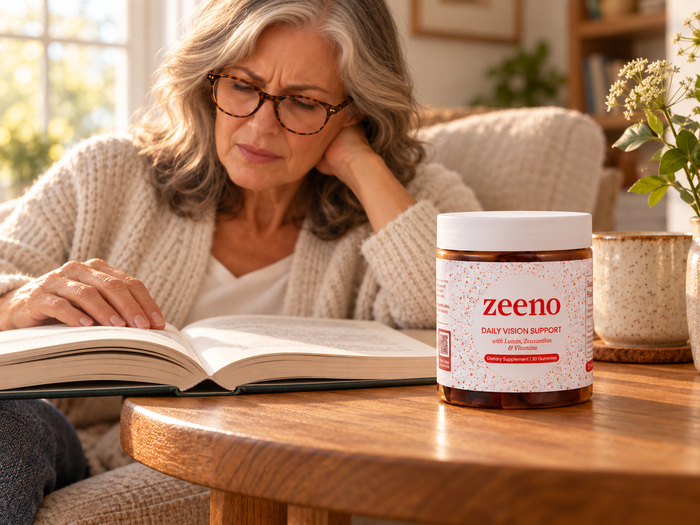
The near-vision part is mechanical — we won't pretend otherwise
Around 40 the lens in your eye stiffens and stops focusing up close. That's presbyopia. No supplement reverses it. If you need readers, you need readers.
But the pigment layer handling glare and contrast? That responds to what you eat.
Supplement rules let us describe how nutrients support normal structures — not claim to treat conditions. Presbyopia is a change in the lens itself, outside what any nutrient reverses.
FDA structure/function claim guidance.
Dry eye does respond, and it's measurable
Dry eyes get written off as just aging. They're also measurable.
Tear production and film stability both improved against placebo over six months. The group taking nothing got worse.
Over 180 days both tear production and tear film stability improved, while the placebo group declined.
Lopresti et al., 2025 — 180-day randomized, placebo-controlled trial.Extra tear film stability after 180 days on the clinical dose of lutein and zeaxanthin.

Glare recovery slows with age — that one moves
Low sun bothers you more at 50 than at 25 because your retina resets slower.
Unlike the stiffening lens, that one moves.
Recovery from bright light improved roughly 17% over a year at this dose.
Hammond et al., 2014; Lopresti et al., 2025.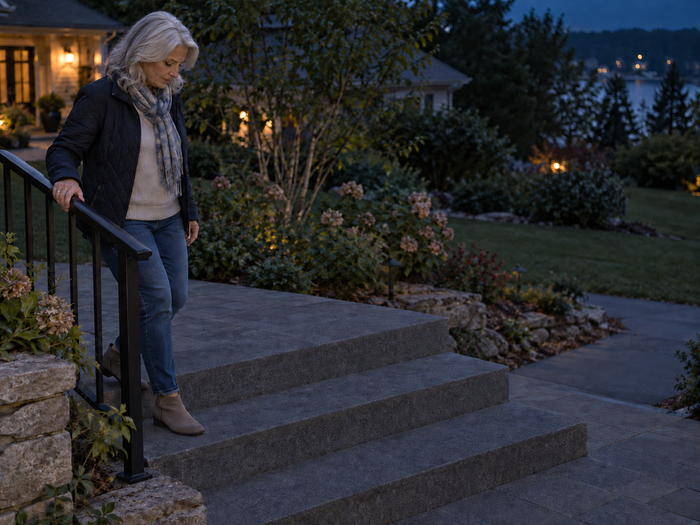
It's usually contrast slipping, not sharpness
You can pass the eye chart and still feel off at dusk. Reading letters is one skill. Separating a grey step from a grey floor is another.
That second one is contrast, and it tracks with macular pigment.
More macular pigment is linked with better contrast and less trouble with glare.
Johnson et al., 2021; Hammond et al., 2014.You can't eat your way out of reading glasses. You might be able to eat your way to better glare recovery and a steadier tear film.
What's realistic8 ingredients. One gummy. Once a day.
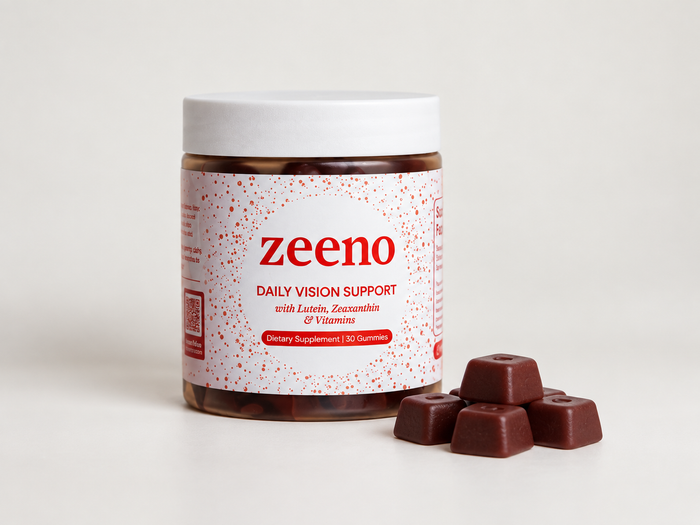
10mg lutein + 2mg zeaxanthin — the dose used in the trials, plus Vitamins A, C, E, Zinc, Bilberry and Grape Seed.
Macular pigment thins with age — and rebuilds with intake
The pigment filtering light inside your eye is made of lutein and zeaxanthin. Your body makes neither, and most diets deliver 1–2mg a day.
Zeeno has 12mg.
Across 46 studies, daily intake measurably raised macular pigment. At this dose over 6 months, it rose 39%.
Systematic review of 46 studies; Stringham & Hammond, 2008.What's realistic, and over what timeline
Supported: macular pigment, recovery from bright light, tear film stability, contrast.
Not supported, so we don't claim it: reversing presbyopia, replacing readers, or treating any eye disease.
It takes months. Keep seeing your eye doctor.
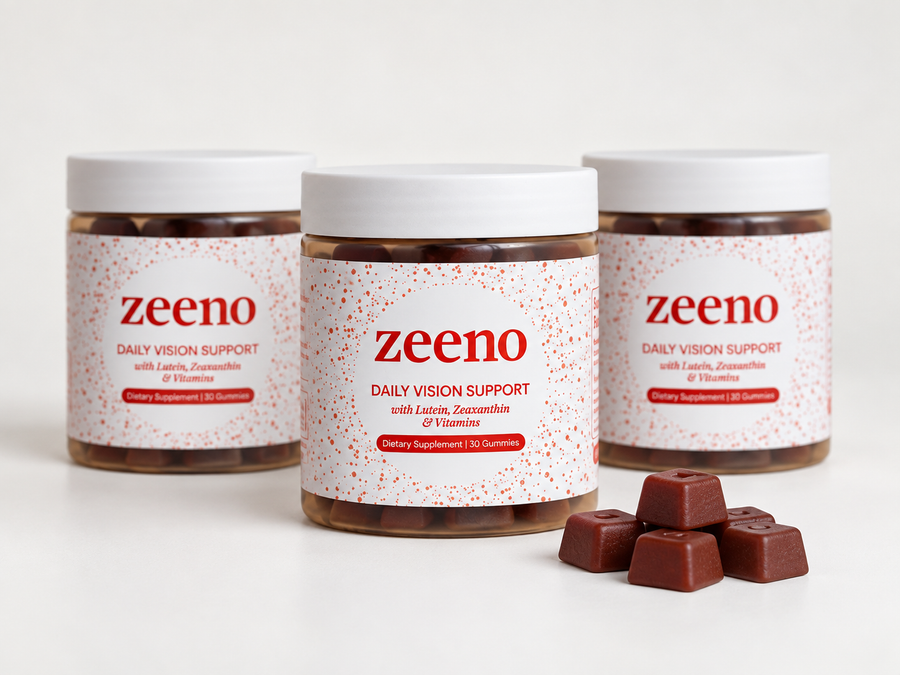
Give it the 90 days the research used
If you don't feel the difference, we'll refund you. Full refund on unopened bottles.
 0:31
 0:31
 0:40
Common questions.
These statements have not been evaluated by the Food and Drug Administration. This product is not intended to diagnose, treat, cure, or prevent any disease. Zeeno does not treat presbyopia, cataracts, macular degeneration or any other eye condition, and is not a substitute for corrective lenses or regular eye exams. Individual results vary. Studies referenced were conducted on lutein and zeaxanthin at the doses noted, not on Zeeno as a finished product.